
The trade to-and-from India so far is not affected. But if the situation continues to remain the same for the next two to three months, it could definitely hurt India trade, including essential cargo.

Since April, India has seen multiple strains of the coronanavirus sweep the nation, upending life and businesses alike. Out-of-home retail and discretionary categories such as durables, auto, fashion, lifestyle, hospitality, food services, travel, and tourism have been the worst-hit as Covid cases remain high, leaving state governments with no option but to curtail mobility and economic activity.

Meanwhile, with China switching its trading partners due to geo-political issues, increased trade with South Africa for bauxite and with the US for coal is also auguring well for vessels with tonne miles going up.

Overall, Tata Steel becomes the seventh non-financial firm, including four oil PSUs to report quarterly revenues of Rs 50,000 crore.

The government has been in discussions to promote such international financial services centres within India as alternatives to places like Singapore.

Discussions are said to have been heating up over how long a tax indemnity clause, which is part of such deals, should run, according to multiple people familiar with the matter.

With the government looking to divest loss-making steel assets, significant interest from secondary players is most likely this time apart from the anticipated list of large integrated primary steel producers, said industry experts. Rashtriya Ispat Nigam Limited (RINL), Neelachal Ispat Nigam Ltd (NINL), NMDC Integrated Steel Plant (NISP)-Nagarnar, Ferro Scrap Nigam Ltd and three units of Steel Authority of India (SAIL) - Alloy Steels Plant, Durgapur; Visvesvaraya Iron and Steel Plant, Bhadravati; and Salem Steel Plant, Salem - constitute the divestment list. All the three units of SAIL have been loss-making for more than five years.


Stocks mutual funds had invested in had risen almost to pre-pandemic levels in March.

With the O2C business outlook on the mend, the Street is also looking forward to news on RIL's proposal to sell up to 20 per cent of the O2C business to a strategic investor like Saudi Aramco.

This year is set to be the third consecutive year when India's share of IPOs has fallen relative to the rest of the world.

Lawyers say compensation may be an uphill task for investors because of a lack of judicial precedent and broader institutional difficulties.

Adani Ports and Special Economic Zone and Adani Green Energy are the other two Adani Group firms to have crossed the Rs 1-trillion mark in m-cap.

'We are working in association with the state government and other transmission companies to make sure that the city never experiences blackouts'

About 50,000 truckers, most of whom are single-truck owners, could be thrown off their businesses due to the recent fuel price hike. "Already the vehicle supply on the road is higher than the requirement. "With the fuel price hike, fleet owners will look to cut down fleet size wherever needed and due to this, small single-truck owners could be at the receiving end," Ashok Goyal, managing director at BLR Logistiks (I) Ltd said. The company has a fleet of 500 vehicles of all types-small, medium and large with pan-India presence.

Companies providing portfolio management services (PMS) had a tough time beating the benchmark index in January, with more than half of the schemes invested in large companies underperforming in the run-up to the Union Budget. The Nifty 50 index was down 2.5 per cent during the month. Only around 44 per cent of PMS schemes did better, among the schemes investing in large-cap companies. The analysis is based on data from industry tracker PMS Bazaar. Half the mid-cap schemes outperformed, while the rest underperformed.

The Union Budget 2021-22 has made it easier for sovereign wealth funds and pension funds to invest in Indian infrastructure projects, but some of the new rules may need more clarity, experts said. The proposed regime requiring investments through holding companies may have adverse tax implications for such funds and may create an arbitrage between the new and old projects, they said. Besides, the ownership structure of holding companies through which investments are to be made requires further clarification, they added.
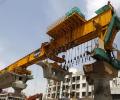
The combined net sales of 42 listed construction and capital goods companies that have declared their third-quarter results so far were down 2.3 per cent year-on-year in Q3FY21 while core operating profit was up just 4.9 per cent YoY during the quarter.

Acquisitions may have played a role in much of the increase.

Faster account opening, which allows investors to start trading without ever leaving their homes or visiting a physical branch of their local brokerage has played a role in the surge.
 © 2026 Rediff.com - Investor Information - Advertise with us - Disclaimer - Privacy Policy - Sitemap - Feedback - About us - Terms of use - Grievances